The Texas Gulf Coast:
Houston
The Texas Gulf Coast:
Houston, which suffered a harder fall than most Texas cities during the mid-1980s, is definitely back in the saddle again. While energy remains its cornerstone, the Houston region's economy has diversified sharply in the past 10 years, spurring a 2.9 percent annual growth rate that was nearly double the nation's 1.5 percent growth rate over that period. By 1995, energy-independent sectors such as computer manufacturing and medical technology made up 44.3 percent of the economy versus 15.7 percent in 1981.
| International business directly and indirectly now accounts for one-third of all jobs in the Houston area, the Greater Houston Partnership reports. The Houston region is home to 1,410 multinational companies, 61 consulates and 32 foreign banks. Fifteen foreign governments have opened offices in Houston for their national oil companies. |
|
"I think Houston is very well suited to compete in the 21st century," said Luli Heras, president of the Economic Development Division of the Greater Houston Partnership.
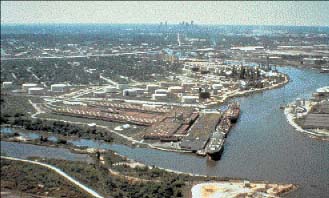
Among U.S. ports, the Port of Houston ranks first in foreign tonnage, first in import tonnage and fourth in export tonnage. For the past five years, the Port of Houston Authority, which in 1995 handled its highest volume of cargo ever, has been investing $20 million to $30 million a year in public port facility improvements.
Like other Texas cities, Houston benefits from the state's proximity to Mexico. Houston is hoping to add to its share of U.S.-Mexico trade when the planned Interstate 69 route from the border through the Houston area to Canada is completed.
Houston also is becoming home to a rapidly growing number of call centers. MCI, GTE, CUC and Globetrotters (a national tour operator) opened call centers between late 1994 and late 1995. Already this year, Software Support, Excel Communications, CardMember Publishing Co., American TeleDirector, Banc One Corp., Southwestern Bell and PrimeCo Personal Communications are planning customer service or telemarketing call centers in the Houston area. The Banc One center alone will translate into an anticipated 1,000 new jobs in downtown Houston.
"Why Houston? Availability of labor, and a number of workers are multi-lingual," Heras said, citing a large number of Spanish-speaking Hispanic residents and a rapidly growing number of Asian and other immigrants able to converse in numerous languages. "That's very crucial as companies compete in the 21st century," Heras said. "When you do business globally, you need to converse with a global market."
Houston also knows how to act fast, she said, citing the Banc One center move. "We got wind of the project June 17. It closed June 27. That's fast," she said.
The city's glut of homegrown engineers -- 62% more common in Houston than they are nationally -- is spurring growth in marine technology and biotechnology business growth in recent years. "Houston is still the energy center of the world," Heras said. "As the industry changes and restructures, we can see relocation and consolidation opportunities."
|
While not engaged in the search for evidence of suspected ancient microscopic life forms on Mars, the Johnson Space Center is producing research with increasingly earth-bound benefits. The Johnson Space Center and University of Texas have established a business incubator called the Johnson Technology Commercialization Center to speed NASA technology to the marketplace. |
Houston has ranked No. 1, 2 or 3 in the top 10 U.S. cities for corporate relocation since 1994, according to PHH Relocation. The realty firm Grubb & Ellis, citing shrinking vacancy rates, reports that 8 million square feet of warehouses will be built in the Houston area in the next two years. Among planned projects is a 600,000-square-foot facility planned by Minneapolis-based Opus South Corp.
More