Also, the Mexican economy registered important progress in consolidating financial, exchange rate and stock market stability in the early months of 1996. Moreover, many industrial sectors recovered and the job market picked up. Mexico's trade surplus continued, foreign investment resumed and both the private and the government sectors engaged in an intense and successful participation in international bond markets. Just one year after the crisis, which was sparked by the peso devaluation, Mexico is well on the road to a solid recovery.
Inflation results were favorable in the early months of the year, despite a series of price hikes in goods and services and increases in the basic wage. The consumer price index (CPI) increased 11.4 percent, just half the hike registered in the same period during 1995. The annual inflation rate in April was 36.9 percent, or 15 percent lower than last December. Inflation estimates as of May are at between 1.5 percent and 2.0 percent, which could mean an annual CPI increase of around 26 percent for 1996, or half the increase registered in 1995.
The drop in interest and inflation rates has been supported by the strengthening of the Mexican currency. Instead of losing ground, as many analysts had predicted, the peso has regained four percent of its values against the U.S. dollar in nominal terms so far this year, without any intervention from the central bank to alter the exchange rate.
The peso's strength relies on several factors: implementation of a strict monetary policy, the Mexican economy's capacity to bring in foreign currency through a trade surplus, foreign investment flows and bond placements on international markets. A stronger peso is considered detrimental by some observers, who believe it will affect Mexico's ability to sustain current export levels. However, a strong currency is generally interpreted as a reflection of improved economic conditions.
Consistent Signs of Recovery
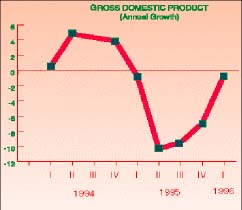
The economy declined 1.0 percent in the first quarter, compared to the same period last year, a far better result than predicated by most government and private sector analysts. In fact, in non-seasonal terms the GDP increased for the third consecutive quarter. Economic production touched rock bottom between the second and third quarters of last year but has since begun to recover.
|
|
In the first quarter of this year, five of the nine big divisions that constitute the GDP registered positive annual growth, particularly mining and manufacturing, with 6.2 percent and 4.2 percent increments, respectively. Areas related to consumer buying power, however, such as domestic trade and communal, social and personal services, continued to contract. High economic growth rates are expected in the coming quarters, compared to the same period in 1995, when the economy registered its biggest dives, and is expected to finish this year with an annual three percent growth, according to official estimates. |
In summary, the Mexican economy has put the worst of the recession behind it and is in a good position to regain a strong and sustained growth. The strict implementation of monetary and fiscal policies has begun to yield positive results, while companies and individuals have made efficient use of the limited available resources. Exports were the key to growth for many industrial sectors and will make an important contribution to this year's expected growth rate. National and foreign investor confidence in Mexico's macro-economic direction and economic potential has improved considerably, which is reflected in foreign capital flows and new projects to set up business in Mexico.
After a deep and lengthy economic crisis, Mexico will enter a period of high, sustained growth in 1996. The correction of the marked imbalances that led to the crisis, intense foreign investment and the pension system reform to kick off in 1997 will be the cornerstones for a sustained improvement in Mexico's well-being.
|
| Rodrigo Fernandez is an editorial associate of THOT Editores S.A. de C.V., a Monterrey-based publishing company. Assistance came from the Mexican Investment Board, SECOFI, Banco de Mexico and INEGI. |
|
Mexico's Comeback
Facts About Mexico
Hottest Investments in Mexico
Investment Opportunities
Free Trade
Advertisers
Return to SiteNet